We have all experienced that moment of panic. You are cruising down the I-15, lost in thought or a good podcast, and suddenly you hear a chime. You look down, and the glowing fuel pump icon is staring back at you. You missed the last exit, and the next one isn’t for miles.
The immediate question is always: How far can I actually drive on empty before the car dies?
The short answer: As a general rule of thumb, most vehicles can safely travel between 30 and 50 miles after the low fuel warning light illuminates. However, this is not a hard-and-fast rule, and pushing your luck can cause expensive damage to your vehicle.
How to Calculate Your “Reserve” Range
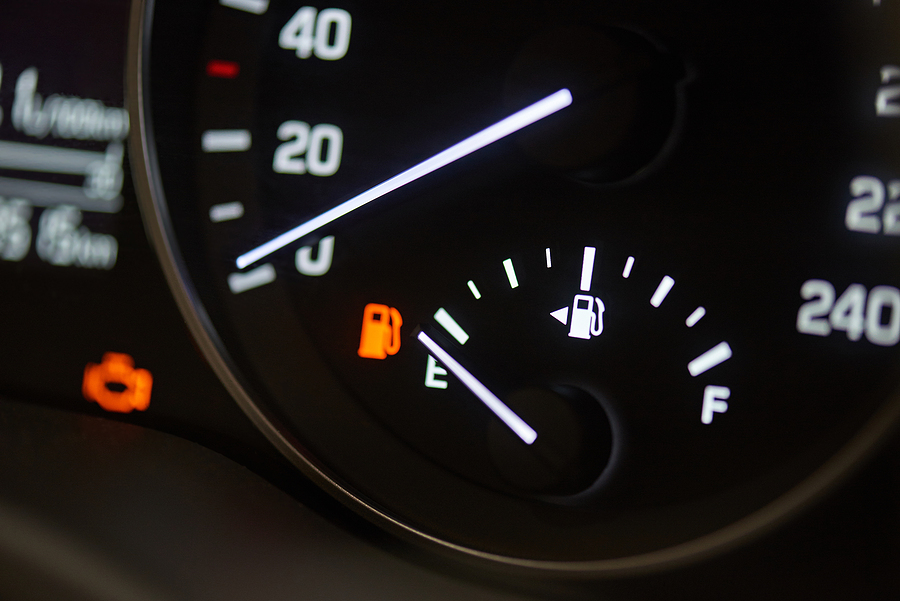
When the fuel light comes on, your tank isn’t actually empty. Most manufacturers design the warning system to trigger when the tank hits about 10% to 15% of its total capacity. This means you typically have one to two gallons of fuel remaining in the “reserve.”
To get a more precise estimate for your specific vehicle, you can do a little math next time you fill up:
- Check your tank capacity: Look in your owner’s manual for your total fuel tank size (e.g., 15 gallons).
- Fill up when the light comes on: Drive until the fuel light illuminates, then immediately pull into a gas station and fill the tank completely.
- Do the math: If your 15-gallon tank only took 13 gallons to fill, you know that your reserve is 2 gallons.
- Multiply by your MPG: If your car averages 25 miles per gallon, your 2-gallon reserve will get you approximately 50 miles before the engine sputters out.
Note: Larger vehicles like trucks and SUVs may have a larger reserve (3-4 gallons) but get much lower fuel economy, while hybrids might have a tiny reserve but can squeeze 40+ miles out of a single gallon.
Why You Shouldn’t Make a Habit of It
While it’s good to know you have a 30-mile buffer in an emergency, you should never routinely drive your car with the fuel light on. Here is why:
1. You Will Burn Out Your Fuel Pump
Your vehicle’s fuel pump is located inside the gas tank. It is submerged in liquid gasoline, which acts as a coolant to keep the pump from overheating. When you drive on empty, the pump is exposed to the air and runs hot. Repeatedly driving with low fuel will eventually cause the pump to burn out prematurely—a repair that can cost over $1,000.
2. You Will Clog Your Fuel Filter
Over time, dirt, debris, and sediment settle at the very bottom of your gas tank. When your tank is full, this isn’t an issue. But when you run the tank nearly dry, the fuel pump is forced to suck up the sludge at the bottom. This debris is then forced into the fuel filter. A clogged filter restricts gas flow to the engine, causing your car to run rough, misfire, or fail to start altogether.
3. It’s a Safety Hazard in the Desert
Running out of gas is annoying in a city, but it is dangerous in the Nevada desert. If your car dies on a remote stretch of highway in the middle of summer, you lose your air conditioning immediately. The inside of a car can reach dangerous temperatures in a matter of minutes.
Key Takeaways
- The 30-Mile Rule: Expect to get roughly 30 to 50 miles once the gas light comes on, but factors like aggressive driving and running the AC will reduce this range.
- Don’t Risk the Pump: Continually driving on empty removes the cooling effect of the fuel and will eventually destroy your fuel pump.
- Play it Safe: Treat the quarter-tank mark as your “empty” line to avoid expensive repairs and keep yourself safe on the road. Need to replace a vehicle that’s constantly running on empty? Browse our massive selection of fuel-efficient new and used vehicles at Valley Automall in Henderson.