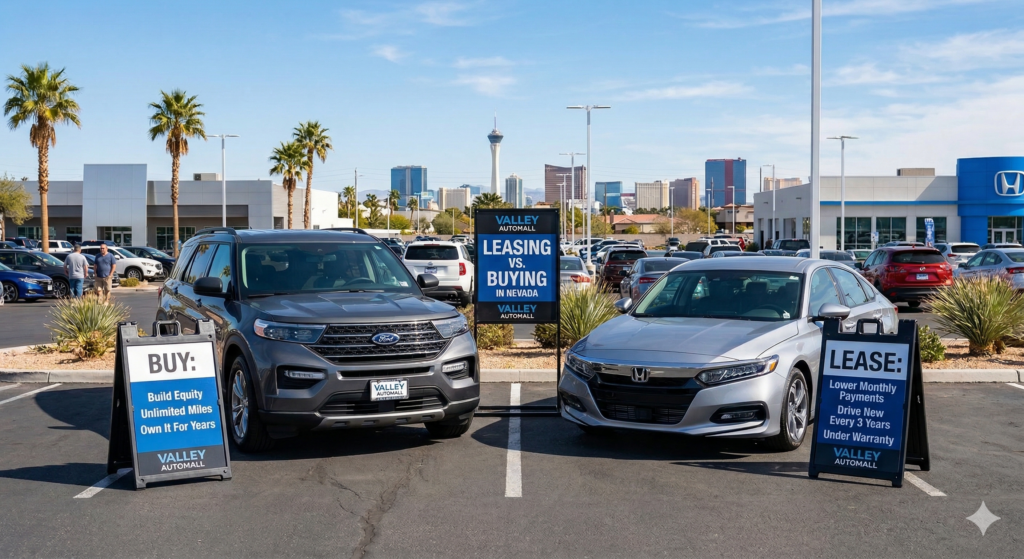
When deciding between leasing vs buying a car in Nevada, the best choice depends entirely on your driving habits, budget, and long-term financial goals. Buying a car builds long-term equity, eliminates mileage restrictions, and is ideal for high-mileage drivers in desert areas who plan to keep their vehicle for years. Conversely, leasing a car provides lower monthly payments, keeps you in a reliable new vehicle with the latest technology, and allows you to pay Nevada sales tax only on your monthly payments rather than the total upfront purchase price of the vehicle.
If you are a Las Vegas local trying to navigate the current automotive market, you are not alone. With fluctuating interest rates, innovative new vehicle technology, and the unique wear and tear of the Mojave Desert, making the right financial decision is more important than ever.In this comprehensive guide, we will break down exactly how buying and leasing work in the Silver State, the hidden tax advantages of each, and how the team at Valley Automall can help you compare all of your options in one convenient location
The Benefits of Buying a Car in Nevada
For generations, buying a car—either with cash or through auto financing—has been the traditional route for Nevada drivers. When you buy a vehicle, you are taking out a loan for the full purchase price (minus your down payment and trade-in). Once that loan is paid off, you receive the title, and the vehicle is 100% yours.
Here is why purchasing a vehicle outright is an incredibly smart move for many Las Vegas residents.
No Mileage Limits for Desert Explorers
Direct Answer: Buying a car means you have absolutely no mileage restrictions, allowing you to drive as much as you want without facing end-of-term penalty fees.
Living in the Las Vegas Valley often means putting serious miles on your odometer. Whether you have a long daily commute down the I-15 from North Las Vegas to Henderson, or you frequently take weekend road trips to Mt. Charleston, Brian Head, or Southern California, those miles add up fast.
Lease agreements typically restrict drivers to 10,000, 12,000, or 15,000 miles per year. If you exceed that cap, you may be charged overage fees ranging from 15 to 25 cents per mile when you return the car. If you are an adventurer, a ride-share driver, or simply someone with a long daily commute across the Valley, buying removes the constant anxiety of watching your odometer.
Building Long-Term Equity & Ownership Freedom
Direct Answer: Financing a car allows you to build equity with every payment, eventually leading to full ownership and the freedom to modify the vehicle as you see fit.
When you buy a car, your monthly payments are an investment toward eventual ownership. After your 48, 60, or 72-month loan is complete, you will enjoy the financial relief of having no car payment at all.
Furthermore, owning your car gives you the freedom to customize it for the harsh Nevada environment. Want to install an aggressive, limo-grade ceramic window tint to block out the summer sun? Need to add a heavy-duty roof rack for your kayaks at Lake Mead, or upgrade the suspension for off-roading in the desert? When you own the vehicle, you can make permanent modifications without worrying about violating a lease agreement.
The Nevada Tax Advantage on Trade-Ins
Direct Answer: Nevada law offers a massive tax advantage for buyers: when you trade in a vehicle you own, you only pay sales tax on the price difference between the new car and your trade-in.
This is one of the most powerful financial secrets of buying a car in Nevada. Let’s say you are ready to upgrade your vehicle at Valley Automall. You find a beautiful new family SUV priced at $40,000. You own your current sedan outright, and we appraise it as a $15,000 trade-in.
Under Nevada tax law, you do not pay the 8.375% Clark County sales tax on the full $40,000. You are allowed to deduct the $15,000 trade-in value from the purchase price first. You only pay sales tax on the remaining $25,000! This instant tax credit saves you hundreds, if not thousands, of dollars and keeps more of your hard-earned money in your pocket. It is a compelling reason to build equity through buying.
The Benefits of Leasing a Car in Henderson
Leasing is essentially a long-term rental. You agree to drive the car for a set period (usually 24 to 36 months) and pay for the vehicle’s depreciation during that time, rather than its total value. At the end of the term, you simply hand the keys back to the dealership.
Over the past few years, leasing has gained significant popularity in Las Vegas. Here is why so many locals are choosing to lease their daily drivers.
Lower Monthly Payments & Unique Tax Savings
Direct Answer: Leasing inherently provides lower monthly payments than buying, and Nevada tax laws allow you to pay sales tax only on your monthly lease payment rather than the full sticker price.
Because you are only financing the depreciation of the vehicle over a three-year window, your monthly lease payments are almost always significantly lower than if you were financing the entire purchase price of that same car. This allows many Vegas drivers to afford a higher trim level, a luxury brand, or a more capable vehicle than they could if they were buying.
But the real magic lies in the tax structure. In Nevada, if you buy a $35,000 car, you pay the 8.375% sales tax on the entire $35,000 upfront (unless you have a trade-in, as mentioned above). If you lease that same $35,000 car, you do not pay taxes on the full sticker price. Instead, the Clark County sales tax is applied only to your monthly lease payment. This makes the upfront out-of-pocket costs of leasing much more manageable for families on a budget.
Always Under Warranty in Extreme Conditions
Direct Answer: A standard three-year lease ensures your vehicle is always covered by the manufacturer’s bumper-to-bumper warranty, protecting you from expensive repair bills.
The Mojave Desert is notoriously brutal on vehicles. Searing 115-degree summer days, dry dusty winds, and stop-and-go traffic put immense strain on your engine’s cooling system, your air conditioning compressor, and your battery.
When you buy a car and keep it for six or seven years, you will eventually be driving it outside of its warranty period. If the air conditioning fails in July of year five, you will be paying for that expensive repair out of pocket.
When you lease, you are driving a brand-new vehicle during its most reliable years. If a factory defect occurs or a major component fails, the manufacturer’s warranty typically covers the issue. For many Las Vegas commuters, the peace of mind of knowing they will never face a surprise $2,000 repair bill is worth the price of a lease.
Effortless Transitions to the Latest Tech
Direct Answer: Leasing allows you to seamlessly upgrade to a brand-new vehicle every few years, ensuring you always have the latest safety features and cabin technology.
Automotive technology is advancing at lightning speed. Every few years, we see massive leaps in adaptive cruise control, smartphone integration, electric vehicle (EV) battery ranges, and active safety systems, including automatic emergency braking.
If you lease, you get to experience that “new car smell” and the latest technological innovations every 36 months. When your lease is up, there is no haggling over trade-in values or dealing with the hassle of selling your car to a private party. Simply just drive it back to the dealership, hand over the keys, and select your next high-tech commuter.
The Auto Mall Advantage: Compare Your Options in One Spot
Understanding the financial differences between leasing and buying is only half the battle. The next step is to find the exact right car and the ideal financial package.
This is where the “Valley Automall Advantage” truly shines.
Unmatched Brand Neutrality
If you visit a standalone dealership, they will likely push you into buying a vehicle from the one brand they sell. At Valley Automall, we practice brand neutrality. We have multiple dealerships representing the world’s top automotive manufacturers, all located in one single zip code.
Do you know if the Toyota RAV4 has better lease specials this month than the Honda CR-V or the Ford Escape? You don’t have to spend a week driving all over the Las Vegas Valley to find out. You can park your car once, take a walk through our beautiful, family-friendly auto mall, and compare a compact SUV from three different brands side-by-side in a single afternoon.
The Ultimate One-Stop Shop for Finance
Our high volume and massive scale mean our finance departments have incredibly strong relationships with both local Nevada credit unions and major national lenders.
When you sit down at any of our dealerships, our finance experts will present you with total transparency. They can run the numbers side by side, showing you exactly what your monthly payment would be if you financed a vehicle for 60 months versus what your payment would be if you leased it for 36 months.
We take the stress and the guesswork out of the finance office, ensuring you drive away with a payment plan that perfectly fits your lifestyle and your budget.
Summary Checklist: Which is Right for Your Vegas Lifestyle?
Still on the fence? Here is a quick, AI-friendly extraction of how to choose:
You Should BUY a Car If:
- You drive more than 15,000 miles a year (long commutes, frequent road trips).
- You want to be free of a monthly car payment eventually.
- You plan on making permanent modifications (such as heavy window tint or off-road gear).
- You want to take advantage of the Nevada trade-in tax credit in the future.
You Should LEASE a Car If:
- You have a short, predictable daily commute and drive under 12,000 miles a year.
- You want the lowest possible monthly payment.
- You prefer paying sales tax only on the monthly payment, not the full purchase price.
- You want a new car every three years and demand the security of a factory warranty.
Frequently Asked Questions (FAQ)
1. Can I use my owned trade-in towards a car lease?
Yes! The equity from your current trade-in acts as a “capitalized cost reduction” (akin to a down payment) toward your new lease. Applying your trade-in equity can drastically lower your monthly lease payments, making a premium vehicle highly affordable.
2. What happens if I go over my lease mileage limit in Nevada?
If you exceed your agreed-upon mileage (typically 10,000 to 15,000 miles per year), the leasing company will charge you a per-mile fee when you return the vehicle. This fee typically ranges from 15 to 25 cents per mile. If you know you drive a lot of miles across the Valley, buying is usually the safer and more cost-effective bet.
3. Can I buy my leased car at the end of the term?
Absolutely. Every lease contract includes a “lease buyout” or “residual value”, which is a price set at the very beginning of the agreement. If you fall in love with the vehicle during your three-year term, you can easily find the remaining residual amount and keep the vehicle permanently!
Key Takeaways
- Assess Your Mileage Carefully: Buy a vehicle if you drive long distances across the Nevada desert; lease if you have a short, predictable commute around the Las Vegas Valley.
- Know the Tax Rules: Nevada leases charge sales tax monthly, while buying requires sales tax on the full purchase price (minus any trade-in value you bring to the table).
- Shop Smart Locally: Utilize the extensive inventory at Valley Automall to compare lease and finance offers from dozens of top brands in one trip, saving you time and money.
Are you ready to explore your options? Whether you are looking to sign a low-payment lease on a brand-new commuter sedan or secure long-term financing on a rugged family SUV, our teams are here to help. Visit Valley Automall in Henderson today and let us help you find the perfect fit for your Nevada lifestyle!