When you take your car in for an oil change, the service advisor will almost certainly ask if you want a tire rotation. It is easy to view this as an optional upcharge and politely decline. After all, the car drives fine, so why pay to have the tires moved around?
The truth is, skipping tire rotations is one of the most expensive maintenance mistakes a driver can make. If you never rotate your tires, they will develop uneven wear patterns that drastically reduce their lifespan, ruin your car’s fuel efficiency, and compromise your safety on the road.
Here is exactly what happens when those tires stay in the same position for too long.
The Problem: Uneven Weight and Workload
Your tires do not share the workload equally. Think about the front of your vehicle. The front tires are responsible for handling the steering. They take the brunt of the force every time you brake (due to forward weight transfer), and in most cars (front-wheel drive), they are also responsible for putting the engine’s power to the pavement. On top of all that, they carry the heavy weight of the engine block.
Because the front tires work significantly harder than the rear tires, the tread on the front tires wears down much faster.
The Consequences of Skipping Rotations
If you leave the tires in their original positions, the front tires will go bald while the rear tires still look brand new. This creates a cascade of expensive problems.
1. You Buy Tires Twice as Often
Tires are meant to be replaced as a complete set of four. If you don’t rotate them, the front tires will wear out prematurely, forcing you to replace them long before the rear tires are done. You will end up in a cycle of constantly buying pairs of tires instead of getting the full 50,000 to 60,000 miles out of a complete set.
2. Dangerous Handling and Braking
Your vehicle’s handling relies on all four tires having equal grip. If the front tires are bald and the rear tires have deep tread, the car will handle unpredictably. In a panic stop or during a sudden rainstorm, the front tires (which do 70% of the braking) will slide, drastically increasing your stopping distance and the risk of an accident.
3. Suspension Strain and Vibrations
As tires wear unevenly, they can begin to cup or scallop—creating small, uneven dips in the tread. This causes the tire to literally bounce down the road rather than roll smoothly. You will feel this as a constant, annoying vibration in the steering wheel or seat, and the constant shaking will put premature wear on your suspension components.
How Often Should You Rotate Them?
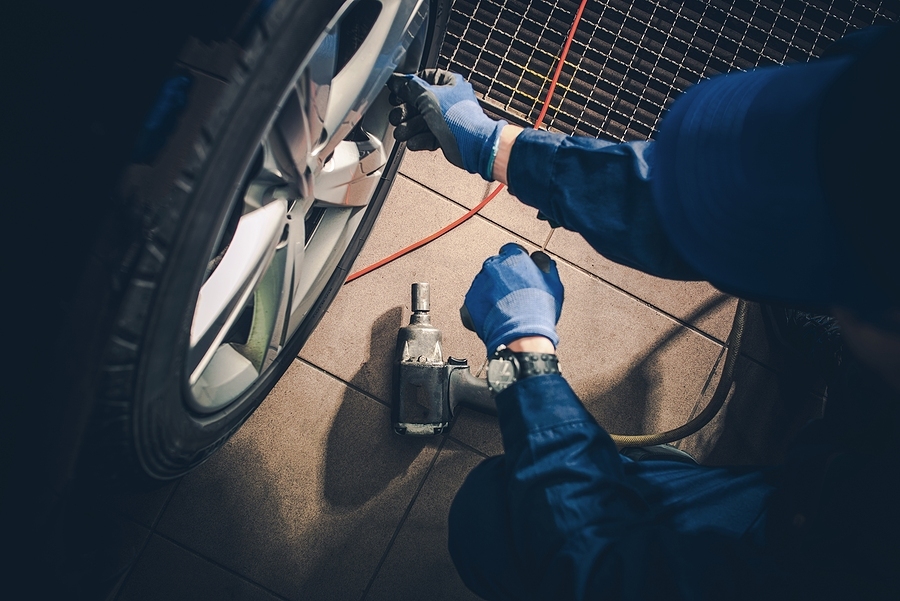
A tire rotation is a simple process where a technician moves the front tires to the rear and the rear tires to the front (often crossing them in specific patterns depending on your drivetrain).
- The Rule of Thumb: Rotate your tires every 5,000 to 7,500 miles.
- The Easy Method: Simply ask for a tire rotation every time you get your oil changed. Tying the two services together makes it impossible to forget.
Key Takeaways
- Front Tires Work Harder: Due to steering, braking, and engine weight, front tires wear down significantly faster than rear tires.
- Rotations Save Money: Moving the tires around allows the entire set to wear down evenly, doubling the lifespan of the rubber.
- Better Safety: Even tread depth ensures predictable handling and shorter stopping distances in emergencies. Need tire service? The expert technicians at Valley Automall are ready to help.